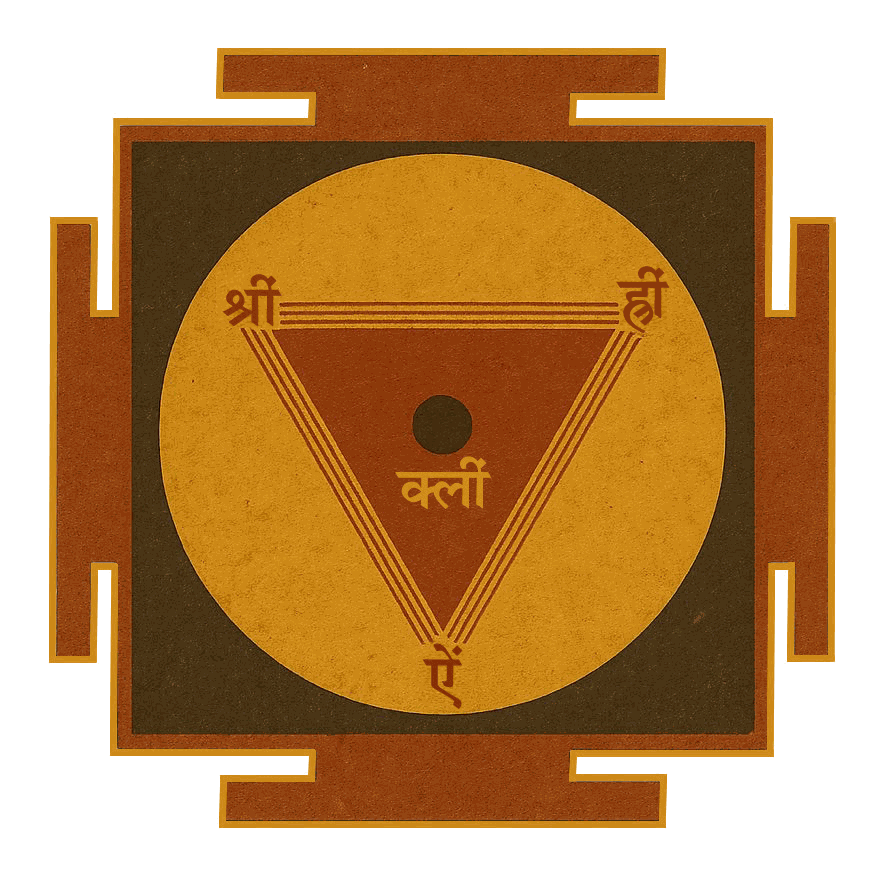
The Ten Great Goddesses — forms of the transcendent Mahadevi
The presence of Dasa Mahavidyas on the Kamakhya hill is unusual in the abundance and variety of images throughout the site. Kamakhya is an important Sakta centre because it is the place where Sati's Yoni fell on the Earth, making it her Aadi Peetha, strongly associated with the Mahavidyas. Kamakhya Temples' Complex is the only site in the world where temples of all 10 Mahavidyas are located.
Both literary and iconographic materials give the general impression that the ten Mahavidyas are different forms of an overarching, transcendent female deity, usually referred to as the Mahadevi. Each Mahavidya confers a certain type of perfection, blessing, or awareness.
The Peetha of Devi Kali is located in the Kali Temple, adjacent to the staired pathway to the Kamakhya Temple. Among the Mahavidyas, the concept of Kali is perhaps the most mysterious. In Sanskrit, Kali literally means TIME. Time is the great womb — birth and death, growth and decay, the essence of our existence.
Devi Kali is located in the Heart Chakra (Anahata Chakra), the seat of the air element or Vayu. Astrologically, she is the residing deity of Shani Graha (Saturn).
The Peetha of Devi Tara is located in the Tara Temple adjacent to the staired pathway. In both Hindu and Buddhist systems, Devi Tara relates to OM — the primal energy (shakti) of sound, the Pranava or the origin of vibration. Tara is the most important of mantric knowledge, the epitome of Mantra Shakti.
Devi Tara relates to the Manipura Chakra (Naval Chakra) and the Ajna Chakra (Third Eye). Astrologically, she is the residing deity of Brihaspati Graha (Jupiter).
The Peetha of Devi Tripura Sundari is in the garbhagriha of the Kamakhya Temple. She is the magnificent eternal beauty which cannot be found anywhere in the universe. Her is the light of our own awareness — the ultimate beauty of pure perception. Also called Rajrajeswari, she is often represented as a young girl of sixteen years, known as Devi Shodasi or Devi Bala.
Located in the Sahasrara Chakra (Crown Chakra), the abode of the immortal nectar (Amrit). Astrologically, she is the residing deity of Budh Graha (Mercury).
The Peetha of Devi Bhuvaneshwari is at the eastern part of Kamakhya hill, on the highest point. Bhuvaneshvari literally means the divine ruler (Ishvari) of the universe (Bhuvana). In the Vedas, she is mentioned as Aditi, the infinite mother and the cosmic womb, who is space. She creates space within our consciousness to give birth to the divine nature within us. She is called Maya.
Located at Anahata Chakra (Spiritual Heart Center). Astrologically, she is the residing deity of Shukra Graha (Venus).
The Peetha of Devi Bhairavi is on the southern side of Kamakhya Temple. She represents the supreme power of speech, which has the nature of fire (Tejas). She is the Word in its unarticulated and primal form as raw energy — the supreme light and heat power, the flame of consciousness itself (Cidagni).
Devi Bhairavi dwells at the base of the spine in the Muladhara Chakra (Root Chakra).
The Peetha of Devi Chinnamasta is adjacent to the staired pathway. The concept of Devi Chinnamasta is a Devi with a severed head — she causes us to dissolve our minds into pure awareness and represents the non-mind (unmana) state, freeing us from the limitations of the mind so that pure consciousness realizes its true nature beyond death and sorrow.
Relates to the Ajna Chakra (Third Eye). Astrologically, she is the residing deity of Rahu Graha (Dragon's Head).
The Peetha of Devi Dhumavati is on the southern slope. Dhuma means "smoke." Her nature is obscuration, not illumination. By obscuring the known, she reveals the depth of the unknown and unmanifest. Portrayed as a widow, she is Shakti without Shiva — pure potential energy. She represents the negative powers of life: disappointment, frustration, humiliation, defeat, loss, sorrow and loneliness.
Astrologically, she is the residing deity of Ketu Graha (Dragon's Tail).
The Peetha of Devi Bagalamukhi is on the south-eastern side. Bagala means "rope" or "bridle" and Mukhi means "face." When sound becomes manifest as light, Devi Tara becomes Devi Bagalamukhi. She grants complete control over our movements and turns each thing into its opposite — speech into silence, knowledge into ignorance, power into impotence, defeat into victory.
Relates to the Ajna Chakra and Anahata Chakra. Astrologically, she is the residing deity of Mangal Graha (Mars).
The Peetha of Devi Matangi is in the garbhagriha of the Kamakhya Temple. Mata means "a thought." Matangi is the Goddess power which has entered into thought or the mind. She is the word as the embodiment of thought. She bestows knowledge, talent and expertise and is the Goddess of the spoken word, including all forms of art, music and dance. Also known as Devi Saraswati.
Resides in the Vishuddha Chakra (Centre of Speech). Astrologically, she is the residing deity of Ravi Graha (Sun).
The Peetha of Devi Kamala is in the garbhagriha of the Kamakhya Temple. Kamala means Lotus, the most sacred flower — a symbol of enfoldment representing the lotus of the heart. She relates to the beauty of perception whereby we see the Divine quality in each thing. She is the most worshipped Devi in this world.
Located in the Anahata Chakra (Spiritual Heart Center). Astrologically, she is the residing deity of Chandrama Graha (Moon).
The Dasa Mahavidyas constitute a complete system of knowledge, generally falling into two groups of five: